SQEC Sovereign‑Grade Integration Pathway
1. Developer Orientation - Understanding the Physics Layer Before Integration
Before introducing the SQEC Integration Pathway, it is important for developers to understand the physics layer they already operate with and how SQECs interact with it. This section provides a clear, architecture‑neutral orientation that helps developers recognise the boundaries of their existing systems and the role SQECs play in delivering Sovereign capability uplift.
This is not remedial material, it is a structured clarification that aligns all developers with a common conceptual model, regardless of architecture, maturity or control‑stack design.
1.1 What Developers Already Operate With at the Physics Layer
Across superconducting, trapped‑ion, photonic, neutral‑atom, silicon‑spin, Majorana‑class, topological, hybrid and National‑laboratory systems, developers work with a physics layer that contains:
Native stability characteristics.
Coherence lifetime behaviour.
Noise pathways.
Spectral‑flow patterns.
Cryogenic‑transition behaviour.
Materials‑driven effects.
Cross‑domain coupling behaviour.
These behaviours exist in every architecture. Developers interact with them indirectly through calibration, control and workload execution.
1.2 What Developers Commonly Add (Control‑Layer Compensations)
Most developers implement compensatory techniques at the control layer:
Calibration routines.
Noise‑suppression heuristics.
Error‑mitigation strategies.
Pulse‑level tuning.
Crosstalk suppression.
Cryogenic stability checks.
These techniques attempt to manage physics‑layer behaviour, not uplift it. They are essential but limited.
1.3 What Developers Do Not Have (Physics‑Layer Uplift)
Very few developers have mechanisms that operate directly at the physics layer. This means they do not have:
Physics‑layer stabilisation.
Spectral‑flow uplift.
Non‑linear Hamiltonian uplift.
Cryogenic‑transition stabilisation.
Multi‑domain coupling uplift.
Topological‑adjacent stability.
Long‑range hybrid‑execution stability.
These are precisely the domains addressed by SQECs.
SQECs do not replace developer techniques. They strengthen them by stabilising the physics layer beneath.
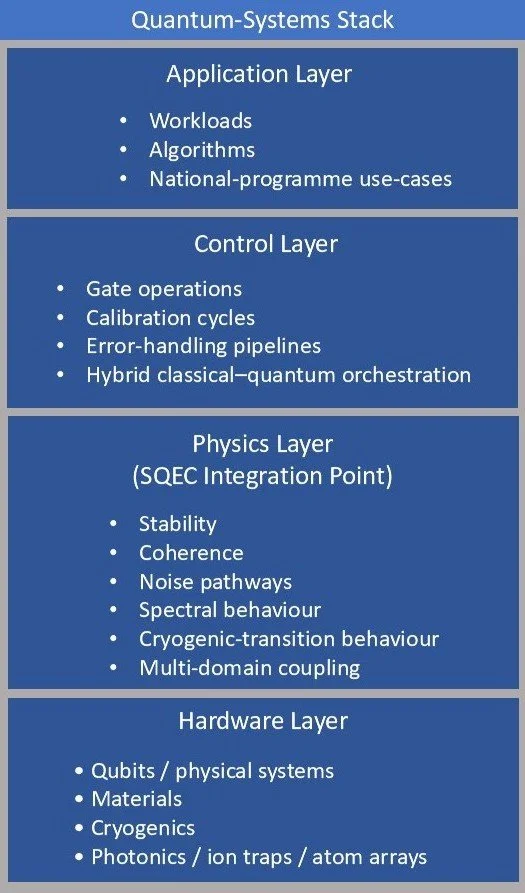
1.4 The Universal Quantum‑Systems Stack
All architectures map cleanly to the same functional stack. This is why SQECs integrate universally.
Every architecture fits this model because it describes functional layers, not hardware types.
SQECs integrate at the physics layer, and the uplift propagates upward through the control and application layers.
2. The Integration Pathway
The Frontier Physics SQECs integrate at the physics‑layer boundary of quantum‑computing and quantum‑systems architectures. They do not modify hardware, control electronics, firmware, or classical HPC systems. Instead, they uplift the behavioural physics layer that governs stability, coherence, noise pathways, spectral‑flow behaviour, calibration consistency and multi‑domain coupling.
This makes SQECs universally compatible with all architectures and immediately deployable in Phase I.
SQECs integrate exclusively at the physics layer. This ensures:
No hardware changes.
No control‑stack rewrites.
No architectural disruption.
No operational downtime.
SQECs uplift the physics layer, and the uplift propagates upward through the control and application layers.
2.2 Integration Methodology (Phase‑I Ready)
2.2.1. Architecture Profiling
Frontier Physics performs a sovereign‑grade architecture profile to determine:
Stability characteristics.
Coherence behaviour.
Spectral‑flow patterns.
Calibration dynamics.
Hybrid‑execution pathways.
Cryogenic‑transition behaviour.
This identifies the optimal SQEC tier and construct.
2.2.2 SQEC Selection
Based on the profile, Frontier Physics selects:
Tier I (Universal): SQECs 1–9.
Tier II (Advanced Sovereign): SQECs 10–21.
Tier II is available from Phase I for architectures capable of deeper physics‑layer uplift.
3. Integration at the Physics Layer
The selected SQEC is integrated at the physics‑layer boundary. This requires:
No hardware modification.
No firmware changes.
No control‑stack redesign.
No algorithmic changes.
It is a non‑intrusive uplift layer.
4. Validation Across Control and Application Layers
The uplift propagates upward, improving:
Gate fidelity.
Coherence lifetime.
Calibration stability.
Noise suppression.
Hybrid execution consistency.
Workload reliability.
Validation is performed across representative workloads and operational regimes.
5. Continuous Sovereign‑Tier Monitoring
Frontier Physics provides ongoing monitoring aligned with Sovereign‑programme requirements:
Stability tracking.
Coherence behaviour analysis.
Spectral‑flow consistency.
Hybrid‑execution reliability.
Long‑range operational behaviour.
This ensures sustained uplift.
6. Integration Across All Architectures
SQECs integrate seamlessly across:
Superconducting.
Trapped‑ion.
Photonic.
Neutral‑atom.
Silicon‑spin.
Majorana‑class.
Topological / adjacent.
Hybrid quantum‑systems.
Hybrid classical–quantum HPC environments.
Cryogenic‑optical systems.
Telecom‑grade quantum networks.
Advanced materials‑driven systems.
National‑laboratory prototypes.
INSERT Full mapping: Expanded SQEC Architecture Matrix
7. Integrated Uplift Outcomes
SQEC integration delivers:
Significant improvements in qubit stability.
Higher gate fidelity.
Extended coherence lifetime.
Reduced noise pathways.
More efficient calibration cycles.
Greater operational consistency.
Accelerated roadmap progression.
Reduced technical and commercial risk.
Enhanced sovereign‑funding eligibility.
Stronger competitive positioning.
Seamless integration into hybrid classical–quantum HPC systems.
Direct uplift for emerging quantum‑systems developments.
This is not incremental optimisation. It is a transformational Sovereign capability layer that fundamentally changes what quantum‑computing and quantum‑systems development programmes can achieve.